Media sharesRead-only mapping
Unraid deployment blueprint
Run Finetic beside an existing Unraid media library.
Finetic uses ordinary Linux container, PostgreSQL and bind-mount contracts that map cleanly to Unraid. The Compose contract is tested; the current guide does not claim that every Unraid release or Community Applications template has been certified.
Pull the signed imageCompiled x64 or ARM64 server
CompleteStart PostgreSQLHealth-checked persistent database
Healthy03
Mount media read-onlyKeep existing libraries in place
Ready04
Start the 30-day trialOpen the graphical first-run wizard
Next- Server
- Public pre-release evaluation through Docker Compose
- Web client
- Available with the server
- Fire TV & Android
- Supervised device testing
- Paid launch
- Pricing and final terms pending
StatePersistent appdata
AccelerationDevice-specific
CertificationAppliance test pending
From source facts to a dependable system.
Each guide connects the visible outcome to the playback, infrastructure and recovery decisions underneath it.
Keep durable state under appdata
Map Finetic configuration, artwork, PostgreSQL data and backups to dedicated persistent directories. Cache can be placed on fast storage and recreated, but database and configuration paths must survive container replacement. Do not place PostgreSQL directly on an intermittently available network share.
Mount user shares read-only
Expose Movies and TV Shows at explicit container paths such as /media/movies and /media/tv, using read-only mode unless a deliberate workflow needs writes. Avoid presenting the same files through overlapping share and disk paths because duplicate traversal can create confusing catalogue candidates.
Align ownership before scanning
Set the configured runtime UID and GID to identities that can traverse the selected shares and write only to Finetic’s persistent directories. Validate with a container-side directory listing before onboarding. Permission errors should be resolved at the mount boundary, not by running the application as root.
Pass through the chosen accelerator
Intel and AMD generally use /dev/dri with the matching render-group access. NVIDIA requires the NVIDIA container runtime and the maintained override. Validate the exact codec, HDR and subtitle path used by your media before relying on hardware acceleration.
Current verification boundary
The maintained images, health checks, PostgreSQL dependency, restore procedure and read-only media model were tested in Linux Docker on Proxmox. This Unraid mapping is derived from those same public container contracts, but the Unraid management UI and a Community Applications listing have not yet been directly certified.
Product evidence
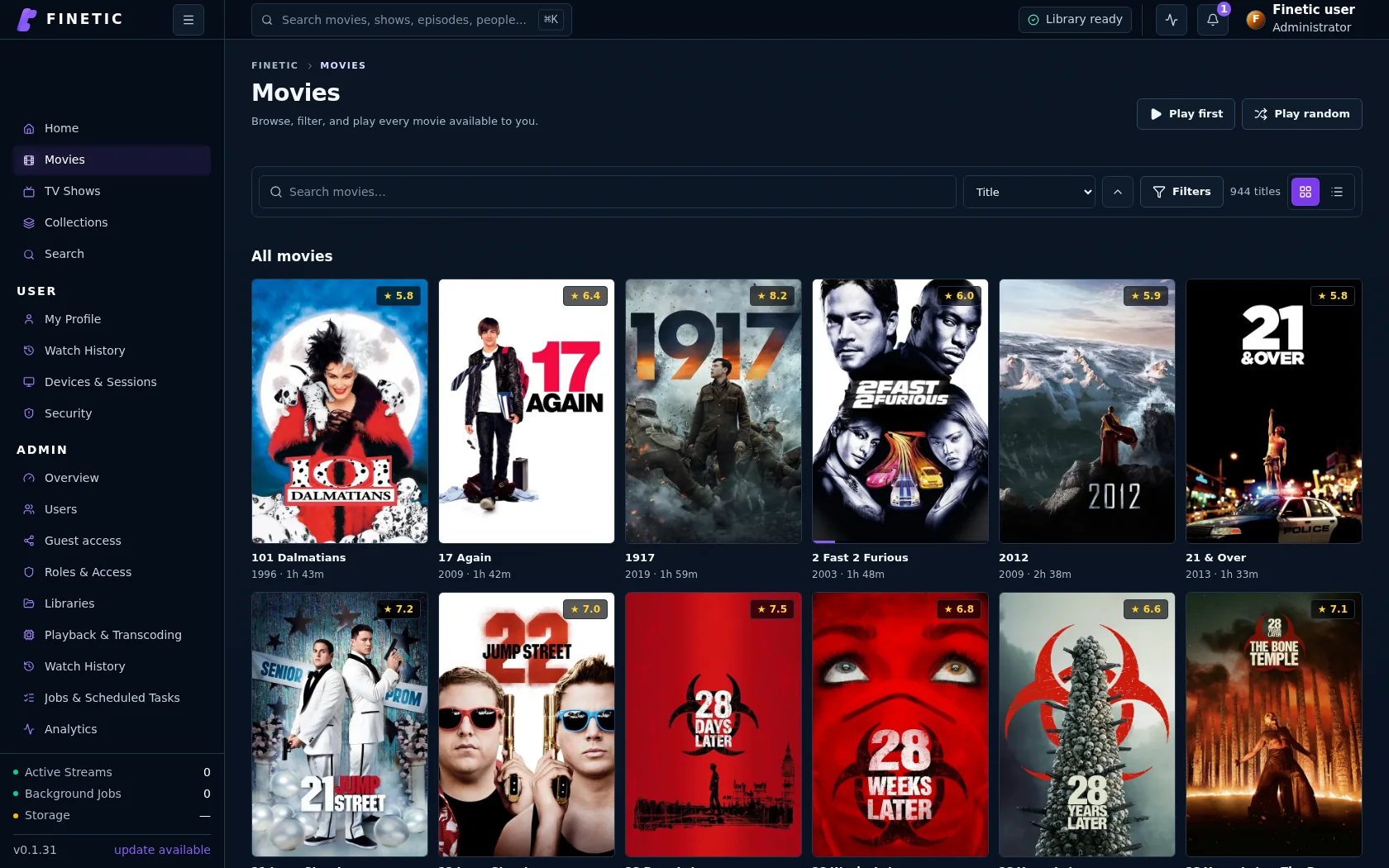
Existing media remains where it is.
The deployment maps stable media shares read-only and keeps all Finetic application state in explicit persistent paths.
Practical self-hosting guides
Move from the playback decision to the hardware, public route and recovery boundary behind it.
MigrationMove safely from Jellyfin
See the tested dry-run, matching, activation and per-user state transfer workflow.
Read guide PlaybackDirect Play vs remux vs transcodingUnderstand what each path changes and why files that look compatible may still need conversion.
Read guide EvidenceBenchmark playback honestlyMeasure first frame, seeks, delivery paths and failures without hiding inconvenient results.
Read guide HardwareChoose media-server hardwareSize CPU, GPU, memory, storage and networking around real simultaneous workloads.
Read guide ProxmoxDeploy inside a dedicated guestUse tested Compose, persistent state, read-only media and explicit GPU delegation.
Read guide UnraidMap Finetic onto UnraidTranslate appdata, media shares, identities and GPU devices without overstating certification.
You are here TrueNAS SCALESeparate storage from runtimePlan datasets, PostgreSQL persistence, cache and backups through the public container contract.
Read guide Remote accessVerify the complete public routeConnect DNS, HTTPS, NAT, byte ranges, HLS and WebSockets without exposing management services.
Read guide SecurityProtect a self-hosted media serverUse explicit accounts, bounded sharing, verified updates, safe diagnostics and tested recovery.
Read guideComplete 30-day evaluation
See whether Finetic earns a place in your home.
Install the compiled server with Docker Compose and evaluate every server feature. No card, automatic charge or source-repository access is required.